
Your First Time in Turks and Caicos: What to Know Before You Land
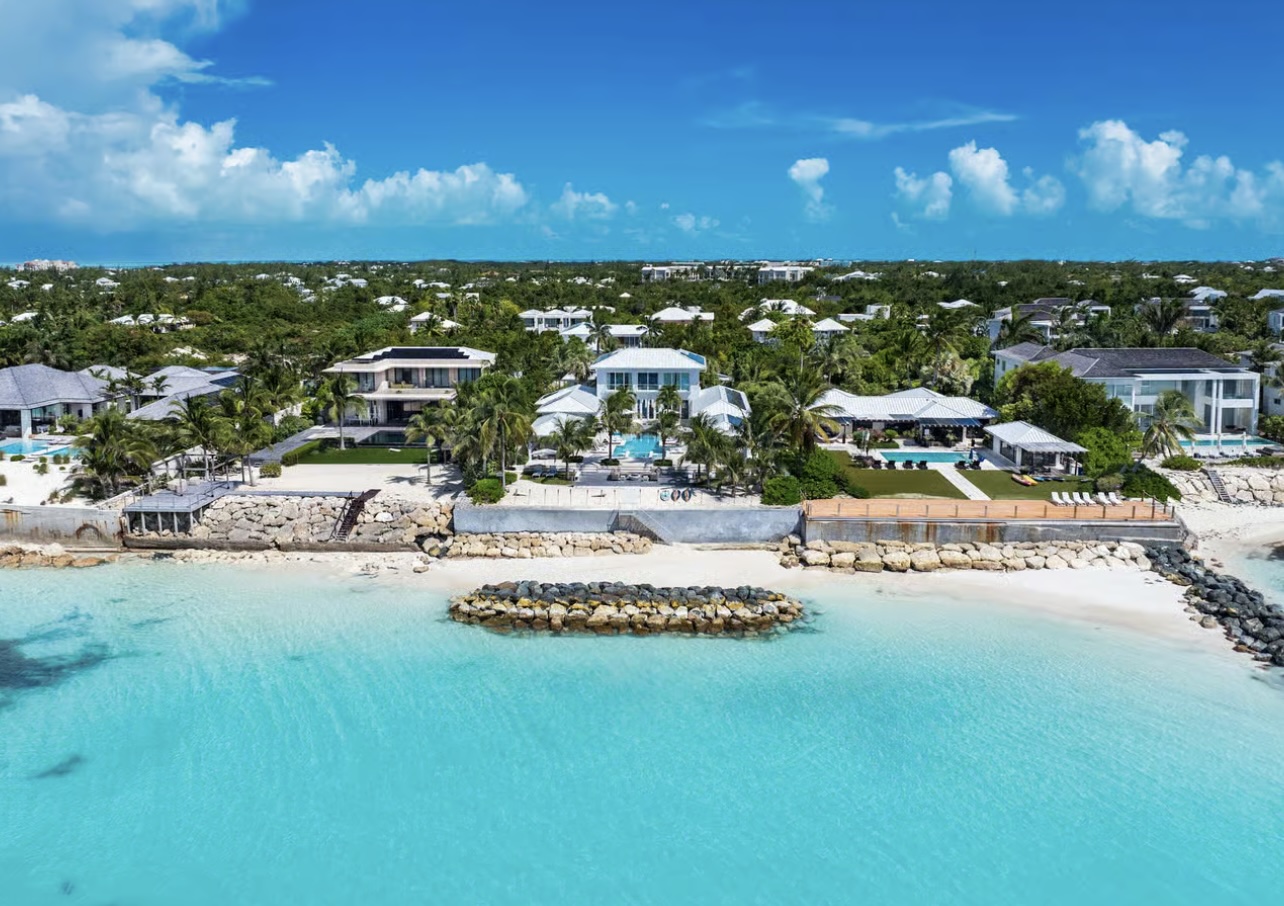
Featured Villa: Milestone, Grace Bay (8 bedrooms)
Turks and Caicos is one of the easiest Caribbean trips to get right. It is English-speaking, it runs on U.S. dollars, and New York is under four hours away nonstop. Almost every visitor stays on one island, Providenciales, which everyone calls Provo.
A few things still surprise people on a first visit, and most of them happen in the first hour. This guide covers what first-timers ask us most, in the order you will need it.
Five things that catch first-timers out
You drive on the left. Most rental cars are still U.S.-style, with the wheel on the left, and roundabouts replace traffic lights.
Taxis charge per person, and there is no Uber. A cheap ride for two is an expensive one for eight. Most villa guests rent a car or book a driver.
The airport backs up on weekends. Lines for immigration and security can run one to two hours on a Saturday. Fly midweek or book Fast Track.
Menu prices are not the final price. Restaurants add a 12% tax and many add a 10% service charge. Villa rates carry the 12% tax too.
One forgotten bullet can mean jail. Bringing in ammunition is a serious crime here, and travelers have been arrested over a single round. Check every bag.
Turks and Caicos at a glance
Where: A British Overseas Territory southeast of the Bahamas, about two hours by air from Miami
Also written: Turks & Caicos, TCI. Providenciales is "Provo"
Main island: Providenciales. The capital, Cockburn Town, is on Grand Turk
Airport: PLS (Providenciales International)
Language: English
Currency: U.S. dollar. Cards are accepted almost everywhere on Provo
Time: Eastern Time with daylight saving, the same as New York all year
Power: 120 volts with U.S. plugs. No adapter needed from North America
Driving: On the left. Your home license is valid for a month
Tap water: Desalinated seawater, generally safe to drink
Weather: About 80°F on average, in a range of 75 to 95°F. The sea is 79°F in winter and up to 85°F in early fall
Seasons: High season is December to April. Hurricane season is June 1 to November 30, peaking from late August through September
Sunset: About 5:10 pm in late December, 5:45 pm in mid-February and 7:00 pm from mid-March
Phones: Country code +1 649, dialed like a U.S. number
Emergencies: 911
Getting there
Nearly every guest lands at Providenciales International Airport (PLS), and the airport is the one part of the trip that rewards planning.
Flights
More than a dozen U.S. cities have nonstop flights, along with Toronto, Montreal and London via Nassau. Typical flight times:
Miami: about 2 hours, on American
Charlotte and Atlanta: about 3 hours, on American from Charlotte and Delta or Frontier from Atlanta
Washington, Philadelphia and Baltimore: 3 hours 15 to 3 hours 25 minutes
New York: about 3 hours 40 minutes from JFK or Newark, on JetBlue, American, Delta and United
Dallas and Houston: just under 4 hours
Boston, Chicago and Toronto: about 4 hours
London: about 12 hours on British Airways, with a stop in Nassau
Orlando, Fort Lauderdale, Detroit and Minneapolis also have nonstop service. New this winter: Denver on United on Saturdays from December 19, and Ottawa on Porter from December 17. Schedules change with the season, so check your dates.
Fly midweek if your villa dates allow it. Saturday and Sunday are the busiest days at PLS.
The airport
PLS is a small terminal that handles a lot of flights at once.
Lines. At peak times, immigration and customs can take more than an hour. There are no separate family lanes.
Fast Track. A paid escort service takes you through dedicated lanes on arrival, and through check-in and security on departure. It starts at about $75 per person. Ask us to book it with your transfer.
The immigration form. Your airline hands out a paper form on the plane, one per traveler. Fill it in with black or blue ink, and have your villa's name and address ready. Home-printed copies are not accepted.
The customs form. You only need one if you are bringing in more than $1,000 of goods that will stay on the island.
Cash. The airport has no currency exchange, and the island's ATMs are often out of service. Bring U.S. dollars with you.
The drive. Grace Bay is 20 to 30 minutes from the airport.
Going home. Be at the airport about two hours before your flight, or earlier if your airline asks. There is no U.S. preclearance, so you clear U.S. customs when you land.
Paperwork
Passport. U.S., Canadian and U.K. citizens need a passport valid for the length of the stay. Most other nationalities need six months' validity. Airlines can apply stricter rules, so check with yours if your passport expires soon.
Visa. Not needed for citizens of the U.S., Canada, the U.K. or the E.U. Visitors are normally admitted for 30 days, and for up to 90.
Return ticket. Officers may ask to see a return or onward ticket.
No online form. There is no e-visa or travel authorization to complete before you fly.
Medication. Keep it in the original packaging, with a copy of the prescription.
Cash. Declare anything over $10,000.
What not to pack
Three rules here surprise visitors, and all three are enforced.
Ammunition and firearms. Bringing in either without police permission is a crime with a 12-year minimum sentence. That includes one stray round in a range bag or hunting jacket, and telling your airline does not count as permission. Empty and check every bag, pocket and case before you pack.
Cannabis in any form. CBD oil, THC gummies, vapes and medical marijuana are all illegal, with or without a prescription.
Spearfishing gear. Spear guns and Hawaiian slings are banned.
What you can bring
Duty-free drinks. Each adult may bring one liter of spirits or two liters of wine.
Food. Commercially packaged food is allowed in your luggage, including sealed supermarket meat and cheese. Home-packed meat and produce are not.
Flying private
Private flights use the dedicated terminals (FBOs) at PLS, which have their own immigration and customs. The airport operates from 6 am to 8 pm, and arrivals outside those hours need special permission. Send us your tail number and arrival time, and we will have your driver at the FBO.
Staying on another island
Private-island resorts such as Parrot Cay, Pine Cay and Ambergris Cay run their own boat or charter-flight transfers from Provo. South Caicos has its own flight from Miami twice a week. Grand Turk and Salt Cay are a short domestic flight away, and those small planes have tight luggage limits.
What we need from you
Send us your flight details as soon as you book: flight numbers, arrival and departure times, number of travelers and bags, and any child seats. Villa check-in is usually 4 pm and check-out 10 am, so tell us if you land early or leave late and we will plan the gap.
Know your neighborhood
Where your villa sits decides how much you drive and which beach is yours. The main villa areas are quite different from one another.
Grace Bay. The center of things: the famous beach, most restaurants and shops, and the Graceway Gourmet supermarket. Many villas here sit a street or two back from the sand, and you can walk to dinner.
Leeward. A gated residential area about five minutes' drive east of Grace Bay. The beach is the quiet continuation of Grace Bay Beach. Boat charters and the North Caicos ferry leave from the marinas here.
Long Bay. Modern beachfront villas on the southeast shore, about ten minutes from Grace Bay. The water is shallow and the trade winds are steady, which makes this the kiteboarding beach.
Turtle Tail. A quiet peninsula on the south side with wide views over the Caicos Banks. Expect privacy and open water rather than a long sandy beach, and a drive of about 20 minutes to Grace Bay.
Chalk Sound and Silly Creek. Villas around a bright turquoise lagoon in the southwest. The shoreline is mostly rock, the views are some of the best in the country, and Grace Bay is 20 to 30 minutes away.
Sapodilla Bay and Taylor Bay. Two small, shallow, sheltered beaches next to Chalk Sound. The easiest water on Provo for small children, with the same drive to town.
Turtle Cove and The Bight. Between Grace Bay and the airport, close to the two best snorkeling reefs you can reach from shore.
Outside central Grace Bay you will drive to dinner and to the supermarket. Ask us what is realistically walkable from your villa.
Getting around
Rent a car or book a driver. Provo has no public buses and no Uber or Lyft, and taxi fares add up fast for a group.
Renting a car
Left side of the road. You drive on the left, but most rental cars have the steering wheel on the left too, as at home. Some are Japanese imports with the wheel on the right.
Roundabouts. They replace traffic lights. Give way to traffic already on the roundabout, which comes from your right.
Speed limits. 20 mph in built-up areas and 40 mph on the highway.
What you need. A valid license from home and a credit card. Most agencies want drivers to be 25 or older.
What it costs. From about $50 a day for a small car, $100 for a mid-size SUV, $150 for a Jeep and $240 for a luxury SUV. A 12% tax and agency fees come on top.
Book early. In high season, and above all at Christmas and New Year, reserve when you book the villa.
Pick-up. Most agencies deliver to your villa or meet you at the airport. Some "airport" offices are a shuttle ride away, so confirm where you collect the car.
Film the car. Take a video of the outside and inside before you drive off. Some agencies charge for sand left in the car.
Skip the 4x4 unless you plan to reach the remote beaches on the northwest coast.
At night. Expect potholes, unmarked speed bumps and glare from oncoming high beams. Drive slowly, and take a driver to dinner if you plan to drink.
Fuel. Gas costs about $6.50 to $7.50 a gallon.
Parking. Free almost everywhere. Never leave bags or valuables in view, especially at beach accesses.
Skip scooters. They are not recommended on these roads.
Taxis
Fares are per person. From the airport, two people pay about $28 to $34 to Grace Bay, $36 to Chalk Sound, $43 to Leeward and $45 to Long Bay. Each extra passenger adds roughly $14 to $16.
No meters. The government sets the fares. Confirm the total for your whole group and your bags before you get in. There is no night rate.
Cash. Most taxis do not take cards. Tip about 15%.
Finding one. Taxis wait at the airport, at some resorts and at the Graceway supermarkets. From a villa, a ride has to be booked.
Avoid "jitneys." These unmarked, unlicensed cars offer cheap rides. Do not use them.
Private drivers
A car service charges per vehicle, not per person, typically $50 to $130 a ride. For four or more people it often costs less than a taxi. Give us your arrival, your dinners and your outings, and we will book a driver for each, with the return.
Stocking the villa
Have your first groceries waiting when you arrive. Use the pre-stocking link in your confirmation email, order about a week ahead, and note any allergies or dietary needs.
Groceries cost more than at home because almost everything is shipped in from Florida. As a guide, a quart of milk is about $4.25, a box of cornflakes $12.50 and a six-pack of local Turk's Head beer $15 to $18.
For top-ups during your stay:
Graceway IGA, Leeward Highway. The largest supermarket in the country, with the widest choice of meat and produce. Open daily, 7 am to 10 pm.
Graceway Gourmet, Grace Bay. Smaller and more upscale, with prepared meals, a deli and a good wine section. Open daily, 7 am to 9 pm.
The Market, Blue Haven Marina in Leeward. A small store with a deli, handy for Leeward villas.
Wine Cellar, Leeward Highway. A dedicated wine and spirits store.
Three things to know before you shop:
No alcohol sales on Sundays. Stores cannot sell beer, wine or spirits on Sundays or Good Friday, and sales are restricted on Christmas Day. Restaurants and bars still serve. If you land on a Sunday, pre-stock.
Cover up. The big supermarkets turn away shoppers in swimwear or without a shirt.
Bring what is hard to find. Sunscreen costs more here, and the choice of snacks, coffee and baby supplies is narrower than at home. Swim diapers are scarce.
Private chefs
A private chef starts at about $500 for dinner or $275 for breakfast, plus groceries and the 12% tax. Larger groups and elaborate menus cost more. The island has a limited number of chefs, so book before you arrive. In a villa with its own chef, budget roughly $75 to $100 per adult per day for food and soft drinks.
Island rhythm
Provo eats early, keeps Sundays quiet and builds its week around a few fixed nights.
Dinner is early. Most kitchens wind down by about 9:30 pm, and very little is open late.
Boats leave on time. "Island time" is real on land, but charters, tours and ferries keep to the clock.
Sundays. Stores sell no alcohol, some attractions close, and on North and Middle Caicos most shops and restaurants shut.
Wednesday night. Da Conch Shack in Blue Hills has a live Junkanoo band. It is packed, so reserve.
Thursday night. The Fish Fry in The Bight starts at 6 pm, with food stalls, live bands and a Junkanoo parade after 8 pm. Bring cash.
December to April. High season. Book cars, boats, chefs and dinners before you arrive. For Christmas and New Year, book them when you book the villa.
January to April. Humpback whales pass through, with the best sightings in February.
August 1 to March 31. Lobster season. Outside those dates no restaurant may serve it.
September and October. The quietest months and the lowest prices, at the peak of hurricane season. Some restaurants and resorts close for part of it.
December 26. Maskanoo, a street festival with costumed Junkanoo bands and food stalls from 6 pm. The location can change, so ask us.
A greeting goes a long way. Say "good morning" or "good afternoon" when you walk into a shop or office.
Beaches
Every beach in Turks and Caicos is public up to the high-tide line, including the sand in front of resorts and villas. None has lifeguards.
Grace Bay. Three miles of soft sand and calm, clear water, lined with resorts and restaurants.
Leeward. The eastern continuation of Grace Bay, with the same sand and fewer people.
The Bight and Bight Reef. The easiest snorkeling on the island. The reef, also called Coral Gardens, starts close to the beach and runs about 350 feet out. Park free on Penn's Road or Stubbs Road.
Smith's Reef. Near Turtle Cove, with more coral and more to see than the Bight. Use the east access with children and beginners, and stay well clear of the marina channel.
Long Bay. Three miles of shallow water and steady wind. Come for kiteboarding and for horseback rides in the shallows.
Sapodilla Bay. A small, shallow, sheltered bay near Chalk Sound. Ideal for toddlers and for sunset.
Taylor Bay. Next door, shallower and quieter still. Bring repellent in the late afternoon.
Malcolm's Road and Northwest Point. Remote and hard to reach, with excellent snorkeling. Go by day, in a Jeep, and leave nothing in the car.
Half Moon Bay. A sandbar beach between two uninhabited cays, reached only by boat. Most boat days stop here.
On a windy day, head for Sapodilla Bay, Taylor Bay or The Bight, which stay sheltered. Seaweed (sargassum) rarely reaches Grace Bay, Leeward, The Bight, Sapodilla Bay or Taylor Bay. Wind-facing shores such as Long Bay can collect it in summer.
Beach and reef rules
Much of the north shore, including Grace Bay, is a national park.
Swim inside the white buoys on Grace Bay, and stay out of the boat lanes marked in red and green.
Watch for boats. Tubing and wake-ride boats can pass fast and close to swimmers. Keep children near you.
Take nothing. Removing shells, coral, sand or animals from a national park is illegal, and so is fishing there.
Do not touch or stand on coral, and do not feed fish, birds or iguanas.
Use reef-safe sunscreen, and let it soak in before you swim.
Snorkel with a partner. Weak swimmers should wear a snorkel vest. Avoid full-face snorkel masks.
No nude sunbathing. Public nudity is illegal here.
Leave valuables at the villa. Do not leave phones or bags unattended on the sand or in the car.
On the water and day trips
Book at least one boat day. The cays between Provo and North Caicos are some of the best scenery in the country, and you can only reach them by water.
Half-day cays cruise. About four hours: snorkeling on the barrier reef, the rock iguanas of Little Water Cay and a swim at Half Moon Bay. A seat on a shared boat costs about $125 per adult.
Private charter. A half day runs about $900 to $1,700 on a small boat or power catamaran, and $3,000 or more on a large yacht, plus the 12% tax. A full day adds stops such as Fort George Cay, the Pine Cay sandbars and a beach barbecue.
Iguana Island. Little Water Cay is a nature reserve with boardwalks. Entry is $20 to $25, and it is open Monday to Saturday, 10 am to 3:30 pm. Ask whether your boat's price includes it.
Whale season. Humpbacks migrate past from January to April, with the best sightings from late January to early March. Trips are small, sell out early and cannot promise a sighting.
Glowworms. On the third, fourth and fifth nights after a full moon, the shallows light up green for about 20 minutes, roughly an hour after sunset. Cruises run only on those nights.
Kiteboarding. Long Bay is one of the top kiteboarding spots in the Caribbean, with shallow water and steady wind. Lessons are easy to arrange.
Horseback riding. Provo Ponies rides along Long Bay Beach and into the water. Book ahead.
Kayak and paddleboard. Paddle the mangrove channels near Leeward to spot turtles, or rent by the hour at Las Brisas restaurant on Chalk Sound, where motorboats are banned.
Golf. The Royal Turks and Caicos Golf Club is an 18-hole course in Grace Bay.
Fishing. Charters usually include the license and gear. Fishing on your own needs a license, and it is banned in the national parks.
Puppies. At Potcake Place in Grace Bay you can take a rescue puppy for a beach walk, free. Walks start at 10 am, Monday to Saturday, first come, first served. Line up by 9 am.
Jet skis and beach vendors
Use licensed, insured operators, not someone selling rides on the beach. Jet skis are banned inside the national parks, which include Grace Bay. Tell us what you want to do, and we will book operators we know.
A day on North and Middle Caicos
This is the classic day trip from Provo: empty beaches, sea cliffs and caves, and very few people.
Ferry. About 30 minutes from Heaving Down Rock in Leeward to North Caicos, several times a day. $70 return per adult. Be at the dock 20 to 30 minutes early.
Car. Reserve a rental car on North Caicos before you go, about $75 to $90 for the day.
See. Mudjin Harbour's cliffs and beach, the Conch Bar Caves ($30 per person, call ahead) and Bambarra Beach.
Know. Avoid Sundays, when ferries are few and most places close. Middle Caicos has no gas station, so fill up on North Caicos. Bring cash and insect repellent.
Eating out
Reserve dinner in high season, and expect to pay more than at home. A meal out often costs 20 to 50% more than a comparable one in the U.S.
Book ahead. From December to April the popular tables fill up, and Coco Bistro in Grace Bay is often booked weeks out. Send us your wish list as soon as your villa is confirmed.
Menu prices. Expect about $17 for a burger, $25 for a local fish dinner, $39 for lobster and $50 for a steak, before tax and service.
The bill. A 12% tax is added. Resort restaurants also add a 10% service charge, and some independent restaurants do too. Read the bill before you tip.
Lobster and grouper. Local lobster is served from August 1 to March 31 and Nassau grouper from March 1 to November 30. Conch is on menus all year.
A grouper warning. Bargain "local grouper" is often imported fish. Ask what was landed locally that day.
Dress. Smart casual in the evening. No restaurant on Provo requires formal dress.
Paying. Ask for the card machine to be brought to your table.
A few places first-timers ask about:
Coco Bistro, Grace Bay. Dinner in a garden of coconut palms. Book it first.
Da Conch Shack, Blue Hills. Tables on the sand and conch every way. Wednesday is the big night, and service is unhurried.
Omar's Beach Hut, Five Cays. Local-style fish, with picnic tables in the shallow water. Best at lunch.
The Marine Room, The Bight. Upscale and dinner only. Reserve, and arrive early for parking.
Caicos Café, Grace Bay. A French-Mediterranean bistro, known for grilled lobster tail in season.
The Thursday Fish Fry, The Bight. Food stalls and live music from 6 pm. Prices match the restaurants, and many stalls are cash only.
Older guides still send people to Bugaloo's in Five Cays. It closed in 2025.
Money
Everything is priced in U.S. dollars, and cards work almost everywhere on Provo.
Cards. Visa, Mastercard and American Express are widely accepted. Card machines occasionally go offline, so carry a backup.
Cash. You need it for taxis, tips, the Fish Fry, beach vendors and the other islands. Bring small bills from home.
ATMs. There are few of them and they are often empty or offline. Expect a fee of about $7, and use them by day.
Taxes. A 12% government tax applies to villas, restaurants, rental cars, boat charters and spa treatments. There is no sales tax.
Service charge. Staffed villas and resort restaurants add 10%, which is shared among the staff. Anything labeled a "city tax" is not a real tax.
Tipping in restaurants. Aim for 15 to 20% in total. If 10% service is already on the bill, add 5 to 8%.
Tipping everyone else. About 15% for taxis and drivers, 10 to 25% for a private boat crew, and $10 to $20 per person on a shared cruise.
What to budget beyond the villa
Tax and service on the villa: 12% tourism tax, plus a 10% service charge at staffed villas.
Airport Fast Track: from $75 per person.
Rental car: about $100 a day for a mid-size SUV and $240 for a luxury SUV, plus tax and fees.
Airport taxi: $28 to $45 for two people, depending on the area, and $14 to $16 for each extra passenger.
Dinner out: about $100 to $150 per adult at the better restaurants, with drinks, tax and tip.
Private chef: from $500 for dinner, plus groceries and tax.
Private boat, half day: $900 to $1,700 for most boats, plus tax and a crew tip.
Shared snorkel cruise: about $125 per adult and $62 per child.
North Caicos day trip: about $375 for two, all in.
Tell us your dates and group size, and we will cost the whole trip in writing before you commit. Every quote we send shows the taxes and service charge, so the total you see is the total you pay.
Practical details
Safety. Most visits are trouble-free, but Provo has crime, and both the U.S. and Canadian governments advise extra caution. Lock doors and windows at night and whenever you go out, use the safe, and check who is at the door before you open it. After dark, drive or take a booked car rather than walking, outside the center of Grace Bay. Do not resist a robbery. Call 911.
Health. Provo has a full hospital, Cheshire Hall Medical Centre, and walk-in clinics in Grace Bay and on Leeward Highway, one with a decompression chamber for divers. Serious cases are flown to Miami or Nassau, so carry travel insurance that covers medical evacuation.
Medication. Bring more than you need. Pharmacies do not stock everything.
Sun. The sun is intense all year. Pack reef-safe SPF 50 and long-sleeve rash guards, and drink more water than usual.
Insects. Mosquitoes appear after heavy rain, mainly in late summer and fall, and at dawn and dusk. No-see-ums come out an hour or two before sunset on some beaches. Pack repellent.
In the water. Look but do not touch. Lionfish, fire coral and sea urchins all sting.
Tap water. Desalinated and generally safe to drink.
Power. 120 volts with U.S. plugs. Electricity is expensive, so keep doors and windows shut when the air conditioning is on.
Phones. Check your carrier's roaming rate before you fly, or buy a travel eSIM. Flow and Digicel sell local SIMs. Wi-Fi is standard in villas.
Hurricanes. The season runs June 1 to November 30 and peaks from late August through September. Storm warnings usually come about a week ahead. If you travel then, buy insurance that covers cancellation.
Children. Tell us their ages before you arrive, and we will arrange cribs, high chairs and car seats. Ask us about pool fencing at your villa.
Drones. Allowed for personal use, but not near the airport. Ask us before you fly one.
Souvenirs. You may take home up to three conch shells. Coral may not leave the country.
Drinking age. 18.
Same-sex couples. Same-sex relationships are legal. The U.K. government describes local attitudes as tolerant but conservative.
Your countdown
When you book
Check every passport covers your whole stay, with six months to spare if you are not a U.S., Canadian or U.K. citizen
Buy travel insurance that covers medical evacuation and cancellation
Ask us to reserve your rental car or driver
Traveling over the holidays? Send your restaurant, chef and boat requests now
A month before
Send final flight details: flight numbers, times, travelers, bags and child seats
Book your boat day, private chef and any whale, kite or riding trips
Send your dinner wish list
Tell us if you want airport Fast Track
A week before
Place your grocery order, noting allergies. Landing on a Sunday? Add your wine and beer
Set up roaming or a travel eSIM
Save your concierge's number and your villa's name and address offline
Get U.S. cash in small bills
Packing day
Empty every bag, pocket and case of ammunition. One round is enough for an arrest
Leave cannabis, CBD products and THC vapes at home
Pack reef-safe sunscreen, rash guards, insect repellent and water shoes
Keep medication in its original packaging, with the prescription, in your carry-on
Pack a pen with black or blue ink for the immigration form
Arrival day
Fill in the immigration form on the plane
Taking a taxi? Agree the total fare for the group before you get in
Drive on the left, and give way to the right at roundabouts
Lock doors and windows at night
Going home
Be at the airport about two hours before your flight
Leave coral behind, and take no more than three conch shells
Message us if a flight is delayed or canceled
We are here to help
Tell us your plans early and we will line everything up: transfers, the right car, groceries, a chef, a boat day and dinner reservations.
Not booked yet? View our Turks & Caicos Villas


